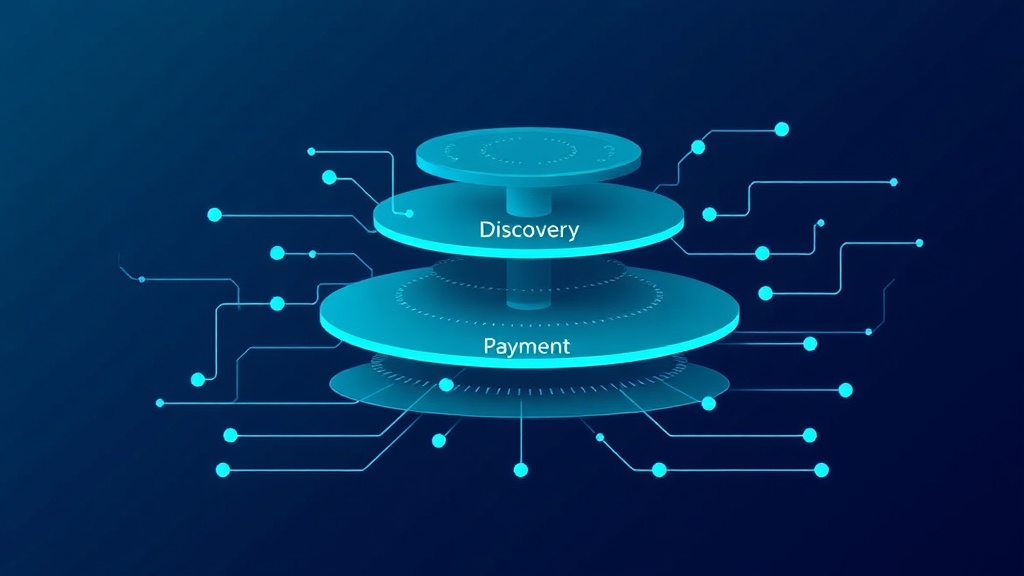
Most ecommerce stores cannot be purchased by AI agents because they are missing at least two layers of the agentic commerce stack: a machine-readable product data layer and a programmatic checkout interface. This is not a future problem. Stripe launched its official MCP server in early 2026 with OAuth support, OpenAI integrated browser-based purchasing directly into ChatGPT via its Computer-Using Agent, and Google AI Mode is surfacing direct product offers. Stores that build the full stack now will capture the first wave of agentic commerce revenue.
This article breaks down the four layers every ecommerce store needs to accept purchases from AI agents in 2026, with technical details, provider comparisons, and implementation priorities.
What Is the Agentic Commerce Stack
The agentic commerce stack is the set of technical capabilities an ecommerce store needs so that AI shopping agents can discover, evaluate, and purchase products without human involvement at every step.
It has four layers:
- Discovery and Data Layer - Structured product data that AI agents can read and compare
- Interaction Layer - Interfaces (MCP tools, APIs, or browser automation) that let agents browse, filter, and add to cart
- Payment and Auth Layer - Secure, agent-compatible payment methods with proper authorization
- Session and Identity Layer - User context, consent tracking, and session management for agent-initiated transactions
Each layer builds on the one below it. You cannot accept AI-driven payments if agents cannot find your products. You cannot complete purchases if your payment system rejects programmatic checkouts.
Layer 1: Discovery and Data Layer
AI agents need machine-readable product data before they can recommend or buy anything. This layer has three components.
Structured Data (Schema.org / Product JSON-LD)
Every product page should include Product schema markup with:
name,description,image,brandofferswithprice,priceCurrency,availabilitygtin13,sku, ormpnfor product identificationaggregateRatingif available
Without structured data, AI agents rely on scraping HTML, which is fragile and inconsistent. A study of ecommerce structured data coverage found that fewer than 18% of mid-market ecommerce stores have complete Product schema on all product pages.
llms.txt and Product Feeds
The llms.txt file at your domain root gives AI agents a concise summary of your catalog and store policies. Combined with a structured product feed (JSON or XML), this lets agents understand your full catalog without crawling every page.
For implementation details, see the llms.txt ecommerce setup guide.
Product Identifiers
GTINs (barcodes), SKUs, and MPNs are critical for agentic commerce. AI agents compare products across stores using these identifiers. If your products lack GTINs, agents cannot match them to the same product on competitor sites, which actually hurts you less than you might think, but it also means agents cannot verify they are recommending the right item.
Layer 2: Interaction Layer
This is where agents actually interact with your store. There are three approaches, and they are not mutually exclusive.
Approach A: MCP Tools (Recommended)
The Model Context Protocol (MCP) is the emerging standard for AI agent interactions. Stripe launched its official MCP server at mcp.stripe.com with full OAuth support, integration with ChatGPT, Claude Code, Cursor, and VS Code.
For ecommerce, MCP tools let you expose operations like:
search_products(query, filters)- Search your catalogget_product_details(product_id)- Retrieve full product informationadd_to_cart(product_id, quantity, variants)- Add items to cartcreate_checkout(cart_id, shipping_address)- Initiate checkoutget_shipping_options(checkout_id, address)- Get available shipping methods
The key advantage of MCP is that it is purpose-built for agent interactions. Agents call tools with structured parameters and get structured responses. No HTML parsing, no form filling, no broken selectors.
Stripe’s MCP implementation uses OAuth for authorization, with granular permission scoping through restricted API keys. This means an AI agent can initiate a payment without getting access to your full Stripe account. The MCP server also integrates directly with OpenAI’s Responses API for building autonomous agents.
For a deeper dive on MCP fundamentals, see the MCP server guide for ecommerce.
Approach B: Browser Automation (CUA)
OpenAI’s Computer-Using Agent (CUA) powers ChatGPT’s agent mode. It can “see” web pages through screenshots and interact with them using mouse and keyboard actions, the same way a human would.
When Operator (now ChatGPT agent mode) launched, it collaborated with companies like DoorDash, Instacart, OpenTable, and Priceline. The CUA model set new state-of-the-art results on WebArena and WebVoyager, the two key browser-use benchmarks.
For stores, this means ChatGPT can technically browse your site, add items to cart, and start checkout without any API integration. But this approach has limitations:
- It is slow (each action requires a screenshot and reasoning cycle)
- It is brittle (UI changes break the flow)
- It requires human handoff for payment details and CAPTCHAs
- Error recovery is unreliable
CUA is a fallback, not a strategy. Stores should optimize for MCP-first interactions while ensuring their UI is navigable by browser agents as a secondary path.
Approach C: REST/GraphQL API
Traditional API access still works. If your store exposes cart, checkout, and payment endpoints via a public API, agents can use those directly.
The limitation is that most ecommerce platforms (especially Shopify) restrict storefront API access. Shopify’s Storefront API lets you build carts and checkouts, but the agent needs to know the API schema and authenticate properly.
Which Approach to Prioritize
| Approach | Speed | Reliability | Setup Effort | Coverage |
|---|---|---|---|---|
| MCP Tools | Fast | High | Medium | Growing (ChatGPT, Claude, Cursor) |
| Browser Automation (CUA) | Slow | Medium | None (works on any site) | ChatGPT agent mode |
| REST/GraphQL API | Fast | High | High | Custom agents only |
The recommended strategy is MCP-first with a CUA-compatible fallback.
Layer 3: Payment and Auth Layer
This is the most critical layer and the one most stores get wrong. AI agents cannot complete purchases if your payment system requires human-only interactions.
The Three Payment Models for Agentic Commerce
1. Agent-Assisted Payment
The agent browses and selects products, then hands off to the user for payment confirmation. This is how ChatGPT agent mode works today: the agent handles discovery and cart management, but prompts the user to take over for payment entry.
This model requires no special payment integration. Your existing checkout works.
2. Agent-Initiated Payment with User Authorization
The agent initiates the payment on behalf of the user, using pre-authorized credentials. Stripe’s MCP server supports this through OAuth: the user authorizes the agent’s MCP client to make payments on their behalf, with scoped permissions.
This is where Stripe’s MCP implementation shines. The agent gets an OAuth token that allows specific operations (like creating charges or confirming payments) without exposing the user’s full Stripe account. Administrators can enable MCP access separately for sandbox and live environments.
3. Fully Autonomous Payment
The agent completes the entire purchase autonomously, including payment. This requires stored payment methods, pre-authorized spending limits, and strong fraud prevention.
No major platform supports fully autonomous payments for ecommerce yet, but the infrastructure is being built. Stripe’s restricted API keys and OAuth-based MCP access are foundational pieces.
Payment Provider Readiness in 2026
| Provider | MCP Support | Agent Auth | Autonomous Payments | Ecommerce Ready |
|---|---|---|---|---|
| Stripe | Yes (official MCP server) | OAuth + restricted keys | In development | Yes |
| PayPal | No native MCP | Limited | No | Partial |
| Adyen | No native MCP | Limited | No | Partial |
| Shop Pay | Shopify ecosystem only | Session-based | No | Shopify only |
Stripe is the clear leader for agentic commerce payments. Their MCP server is production-ready with OAuth, their API supports restricted keys for agent access, and they have explicit documentation for building autonomous agents.
Fraud Prevention for Agent Transactions
Agent-initiated transactions look different from human transactions in your fraud detection system. Here is what to do:
- Whitelist agent user agents: AI agents identify themselves in request headers. Make sure your WAF or fraud tool does not block them.
- Use Stripe Radar with agent-aware rules: Stripe Radar can distinguish between agent-initiated and human-initiated transactions.
- Set spending limits: For agent-assisted payments, set per-transaction and daily limits.
- Log agent sessions separately: Track agent-initiated checkouts separately from human checkouts so you can monitor for anomalies.
Layer 4: Session and Identity Layer
AI agents operate on behalf of users. Your store needs to handle this identity delegation properly.
User Context Passing
When an AI agent interacts with your store, it should pass user context:
- Who is the agent acting for (user ID or email)
- What permissions the user has granted (browse only, add to cart, or purchase)
- Session continuity (can the agent resume a previous session)
MCP handles this through the OAuth flow. The user authorizes the agent, and the agent carries an OAuth token that identifies the user.
Consent and Audit Trails
Every agent-initiated action should be logged with:
- Timestamp
- Agent identifier (which AI service made the request)
- User who authorized the action
- Action taken (view product, add to cart, initiate payment)
- Outcome (success, failure, required human intervention)
This audit trail is essential for dispute resolution and regulatory compliance.
Session Persistence
AI agents may complete a purchase across multiple sessions. For example, an agent might add items to cart today and complete checkout tomorrow after user confirmation. Your cart and checkout systems need to support session persistence with expiration policies.
Implementation Priority: What to Build First
Not all layers are equally urgent. Here is the recommended priority order:
Priority 1: Discovery and Data Layer (Week 1-2)
This is foundational. Without structured product data, nothing else matters.
- Audit your Product schema coverage using Google Rich Results Test and Schema.org validator
- Add missing schema markup to all product pages
- Create
llms.txtwith your store summary and key catalog URLs - Ensure GTINs/SKUs are present in your structured data
Tools like Shopti can audit your store’s agent discoverability score and identify gaps in your structured data coverage.
Priority 2: Interaction Layer (Week 3-6)
Set up MCP tools for your store:
- Define your tool schemas (search, product details, cart, checkout)
- Build an MCP server that wraps your existing store API
- Test with Claude Code or ChatGPT’s developer mode
- Ensure your site is also navigable by CUA agents as a fallback
Priority 3: Payment and Auth Layer (Week 5-8)
- If you use Stripe, enable MCP access in your dashboard
- Configure OAuth for agent authorization
- Set up restricted API keys with appropriate permissions
- Test agent-initiated payments in sandbox mode
- Update fraud detection rules to handle agent traffic
Priority 4: Session and Identity Layer (Week 7-10)
- Implement session persistence for agent-initiated carts
- Build audit logging for all agent actions
- Set up consent management for user authorization
- Test end-to-end agent purchase flows
Real-World Data Points
Here are three data points that illustrate why this matters now:
Stripe launched its official MCP server with OAuth support in early 2026, with direct integration paths for ChatGPT, Claude Code, and OpenAI’s Responses API. This is not a beta or developer preview. It is production infrastructure. (Source: Stripe MCP Documentation)
OpenAI integrated browser-based purchasing into ChatGPT via its Computer-Using Agent, which set state-of-the-art results on WebArena and WebVoyager benchmarks. Operator (now ChatGPT agent mode) launched with partnerships including DoorDash, Instacart, and Priceline, proving that agent-driven commerce is live in production. (Source: OpenAI Operator Announcement)
The MCP specification reached its 2025-03-26 version with formalized OAuth support, signaling that the protocol is mature enough for production use. Major infrastructure providers (Stripe, Anthropic, OpenAI) are shipping MCP integrations, not just experimenting. (Source: Model Context Protocol Specification)
Common Mistakes
Mistake 1: Building Only for Browser Automation
Some stores focus exclusively on making their UI navigable by CUA agents. While this is useful as a fallback, it is slow and brittle. MCP tools are 10-100x faster and far more reliable for structured interactions.
Mistake 2: Ignoring Payment Auth
Even if agents can browse and add to cart, they will fail at checkout if your payment system is not designed for programmatic access. Stripe MCP handles this, but most other payment providers do not yet.
Mistake 3: Treating Agent Traffic as Bot Traffic
Many stores block automated requests at the WAF level. If you block AI agents from accessing your product pages and APIs, you are blocking potential revenue. Configure your robots.txt and WAF rules to allow legitimate agent access. For guidance, see the robots.txt audit guide for AI crawlers.
Mistake 4: Waiting for Platform Support
Shopify, WooCommerce, and other platforms are moving slowly on agentic commerce. Do not wait for them. You can build MCP tools on top of your existing platform using its API. The Shopify agentic plan analysis covers what Shopify currently provides and what it does not.
FAQ
What is the agentic commerce stack?
The agentic commerce stack is the set of technical capabilities an ecommerce store needs so AI shopping agents can discover, evaluate, and purchase products. It includes four layers: a discovery and data layer (structured product data), an interaction layer (MCP tools or APIs), a payment and auth layer (agent-compatible payments), and a session and identity layer (user context and consent management).
Does my store need MCP to accept AI agent purchases?
MCP is the recommended approach but not strictly required. AI agents can also interact with your store through browser automation (like OpenAI’s CUA) or traditional REST APIs. However, MCP provides the fastest and most reliable agent interactions because it is purpose-built for structured tool calls. Stripe’s official MCP server makes payment integration straightforward for stores using Stripe.
Which payment providers support agentic commerce in 2026?
Stripe leads with a production-ready MCP server that supports OAuth authorization, restricted API keys, and integration with ChatGPT, Claude, and OpenAI’s Responses API. PayPal and Adyen do not yet have native MCP support. Shop Pay works within the Shopify ecosystem but is not interoperable with other agent platforms.
How do AI agents handle payment without storing credit cards?
AI agents use OAuth authorization to act on behalf of users. With Stripe’s MCP, the user authorizes the agent through an OAuth consent flow. The agent then receives a scoped token that allows specific payment operations without directly handling credit card data. The user can revoke access at any time from their Stripe dashboard settings.
Will AI agent traffic trigger my fraud detection?
Yes, agent-initiated transactions often trigger default fraud rules because they exhibit programmatic patterns. To prevent false positives, whitelist known agent user agents, use Stripe Radar with agent-aware rules, set appropriate spending limits, and monitor agent sessions separately from human sessions.
Sources
Stripe. “Model Context Protocol (MCP).” Stripe Documentation, 2026. https://docs.stripe.com/mcp
OpenAI. “Introducing Operator.” OpenAI Blog, January 2025 (updated July 2025). https://openai.com/index/introducing-operator/
Model Context Protocol. “Specification 2025-03-26: Authorization.” https://modelcontextprotocol.io/specification/2025-03-26/basic/authorization
Check your store agent discoverability score free at shopti.ai.